CAPITAL FORMATION IN THE AGRICULTUREAL SECTOR (Since The Economic Reforms)
The growth of any economy or sector primarily depends on changes in demographic composition, capital accumulation, and innovation. Capital is one of the crucial factors in the growth/production process. It is a fact that during the green and post-green revolution periods, both public and private capital formation in agriculture made a significant contribution to the farm sector's growth. Initially, agricultural development is driven by public investment in agricultural infrastructure, extension services, markets and storage facilities development, etc.
Encouraged by their increased returns due to infrastructure improvements by such investments, farmers were induced to make private investments in land development, groundwater irrigation, farm mechanization, HYV seeds, chemical fertilizers, etc. The private corporate sector entered agricultural R&D, extension, marketing, contract farming, and other agricultural-related services more recently. These investments have substantially supplemented the public investment in agriculture. Poor farmers face scarcity of capital as they cannot make investments in fixed assets. The government has set up a fund to provide financial assistance to small and marginal farmers in India. It aims to help poor farmers who are unable to invest in their farming businesses. Thus, in the face of this ground reality, making capital affordable to about 80% of small farmers is a critical issue that needs policy attention.
ROLE OF CAPITAL FORMATION IN AGRICULTURE
Capital and labor are the two essential factors of production. For agriculture to perform its diverse operations quickly and economically, both fixed capital and working capital are required. Capital training in agriculture helps to advance technology by upgrading production borders. They do so with several advantages such as increased yield, changes in crop pattern, reduced losses before and after harvest, etc.
Because of a relatively large land area and a large agricultural labor force, India can play a significant role in the global market for farm products. Through better storage and transportation facilities, capital formation also aids in improving the quality of agricultural produce. As a result, the prospects for agro-exports improve. It helps to ensure food security for the growing population and raw material security for the agro-industries in the process.
Classifying the capital formation into the public and private sectors will help assess its role in agriculture. The public-sector capital formation comprises investment made by central, state, and local governments to create various tangible and intangible assets. Agriculture investment by the public and private sectors is both complementary and substitutive. Evidence proves that private investments in agriculture are stimulated by public investments in irrigation, roads, and power projects. Farmers would not need to invest in groundwater irrigation if the government provides supplement surface irrigation and ensures a consistent irrigation water supply for agriculture. It suggests that the complementarity effect is manifested in individual farmers' induced investment.
Thus, while an increase in public investment positively impacts private investment, there could also be situations where private investment may increase to compensate for the decline in public investments. This asymmetry in the impact of increasing and decreasing public investment on private investment is natural. Even though private agri-business companies and input dealers also provide access to the new technology and inputs to the farmers, as is the case under contract farming, there can be no substitute for the larger purpose of a general kind that the public investments generate.
CAPITAL FORMATION IN THE AGRICULTURE SECTOR SINCE THE ECONOMIC REFORMS
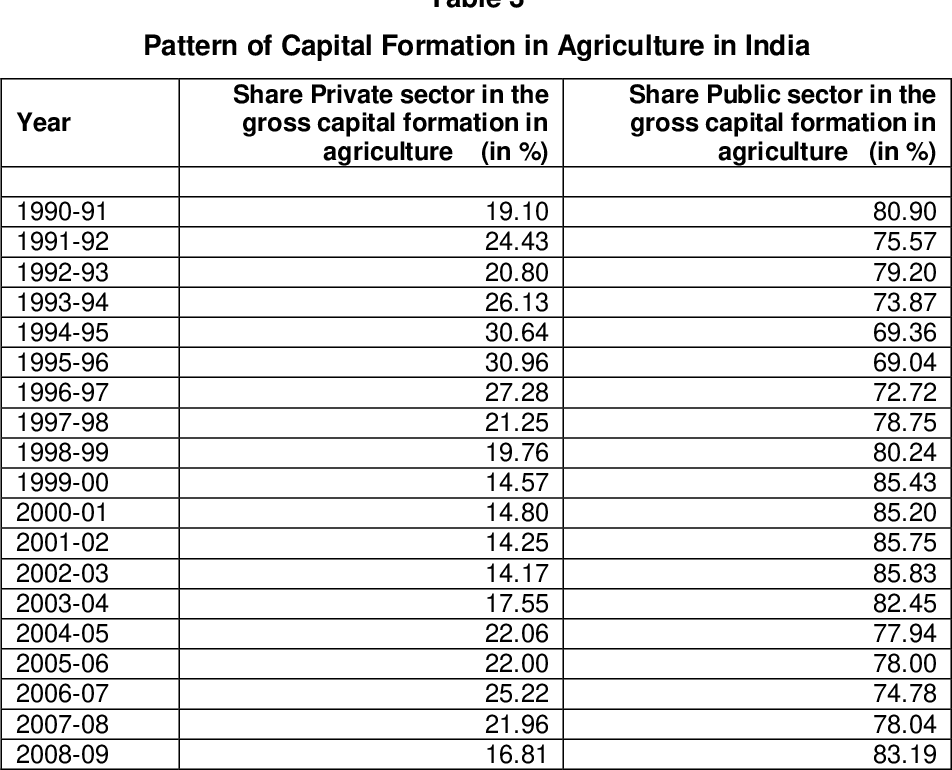
Agriculture is the most prime sector of the Indian economy. It is a source of livelihood and food security in the country and of particular importance to the economy's low-income, poor and vulnerable sections. There was a significant concern about the falling share of public sector formation in agriculture in the early nineties. The Indian agricultural sector is affected by various constraints like traditional methods of cultivation, dependence on monsoon, etc. Lack of new capital formation has slowed the pace of and pattern of technological development and agricultural productivity. Both public and private capital formation contributed significantly to the growth of the agricultural sector only during and after the green revolution.
In the beginning, the public sector mainly invested in:
- agricultural infrastructure (like power, roads, irrigation, and R&D),
extension services,
development of markets and storage facilities, etc.
After that, seeing a noticeable increase in the return due to the investment in infrastructure, the farmers were induced to make private investments in land development, groundwater irrigation, farm mechanization, HYV seeds, chemical fertilizers, etc. More recently, the private corporate sector also entered into agricultural R&D, extension, marketing, contract farming, and other agricultural-related services. Although the agricultural industry includes more labor-intensive activities, it also requires a large amount of fixed and working capital to perform various agricultural operations efficiently.
The share of agriculture investment in total investment has declined more rapidly in the 1990s to 7.9 percent of GDP. The percentage of the public sector in the total investment has also sharply declined up to 6.5 percent in the 1990s; the private sector investment increased simultaneously. The private sector investment also began to decline over the years and showed a similar trend to the public sector. Thus, the decline in investment in the agricultural sector is due to the lower number of shares of both public and private sector investments. The contribution of the agricultural industry to the overall GDP has also been declining drastically, especially during 2001-02. The ratio of gross Capital Formation to GDP, a measure used to assess the investment efficiency in a sector, in agriculture has declined to 6.5 percent in the 1990s from 8 in the 2000s. Furthermore, the share of agricultural sector investment in GDP declined, partly caused by falling in public investment in irrigation since the mid-1990s.
Policy Initiatives are taken by the government
The importance of adequate investment in agriculture compelled the government and RBI to take up several policy initiatives like,
There is an asymmetric impact of public investment on private investment, i.e., an increase in public investment creates a positive impact on private investment, but a fall in public investment leads to an increase in private investment. Thus the government should make suitable policies and development support for the private sector to fill in the gap in the investment.
An emphasis can be made on the shift from present situations where infrastructure investment is dominated by the public sector towards a system where both public-private partnerships function.
Institutional transformation through social capital formation helps increase the efficient use of capital.
The public sector alone can not fill in the investment gap in agriculture, thus private investment can play an important role in the perspective of a huge investment gap.
Microfinance and other credit facilities support agricultural production through two channels meeting short-term working capital needs and long-term investment needs in the sector. It is estimated that about 95% of the agricultural machinery in India is procured with the help of loans from formal credit institutions (Sarkar, 2013)
A WAY FORWARD
Agriculture, which contributes significantly to GDP, employment, and income, has had a stagnant capital formation and growth rate. This has harmed the economy's overall growth. Agriculture investment has been declining, and this is one of the main reasons for the sector's declining productivity and low capital formation. Private investment in the sector has also been low and must be stimulated through appropriate measures.
Some thrusters to the investment and investment credits can be:
Channeling public investment into agricultural infrastructure, especially in poor states.
Increased investment in research and development of crop varieties, livestock, and efficient technology packages and increased attention to socioeconomic factors, environmental constraints, and other factors.
Effective and credible technology, procurement, assessment, appropriate linkages, and partnership with an emphasis on reaching small farmers.
From an agricultural point of view, constraints in irrigation coverage have been the main reasons why public investments in the agriculture sector have been declining. Concerted efforts must be taken to overcome this problem and expedite the ongoing projects.

CONCLUSION.
Capital formation in agriculture has been losing its share, more rapidly since the 1990s led by a loss of momentum in public sector investment and declining farm credits. The share of capital to agriculture and allied activities in total development expenditure in the case of agriculturally important states i.e., Punjab, U.P, Gujrat, Bihar, and Karnataka have been below the national average. Inadequate capital formation has slowed down the pace and pattern of technological and infrastructural development with adverse effects on agricultural productivity
There is a pressing need for fundamental changes in strategies to accelerate the pace of capital formation in agriculture by targeting and downsizing subsidies and plowing back the resources generated to the agriculture sector as an investment in irrigation and infrastructure activities. The government also needs to create a favorable environment for developmental support to the private sector to fill in the investment gaps in agriculture. Thus, increasing the rate of investment holds the key to providing the much-needed structural break required to lift Indian agriculture out of its stagnant rate of capital formation.
Department of Economics, Lady Doak College. (2013). Capital Formation in Indian Agriculture in the Era of Economic Reforms. T. Maheswari. Indiastat: Socio-Economic Statistical Data and Facts About India
Golait, R., & Lokare, S. M. (2008). Capital Adequacy in Indian Agriculture: A Reposite. Reserve Bank of India Occasional Papers, 29(1), 79.
Fortune Business Insights. (2020, May 11). Monoclonal Antibody Therapy Market to rising at 14.0% CAGR till 2027; Growing Investment in Product R&D will Create Several Opportunities for Market Growth, says Fortune Business InsightsTM. GlobeNewswire News Room. Monoclonal Antibody Therapy Market to Rise at 14.0% CAGR till 2027; Growing Investment in Product R&D
Mazelis, L., Lavrenyuk, K., Krasko, A., & Krasova, E. (2020, March 30). Development of a Fuzzy Dynamic Model for the Formation of the Optimal Allocation of Financial Resources for the Maximum Development of Regional Human Capital. Atlantis Press. Development of a Fuzzy Dynamic Model for the Formation of the Optimal Allocation of Financial Resources for the Maximum Development of Regional Human Capital
Mkentane, L. (2021, June 14). Government sets up agricultural fund for youth, women and disabled people. BusinessLIVE. Government sets up agricultural fund for youth, women and disabled people
Reserve Bank of India - Database. (n.d.). Reserve Bank Of India. Retrieved August 16, 2021, from https://www.rbi.org.in/scripts/BS_VIEWContent.aspx?ID=191
Balanced growth path. (n.d.). Growth Study Guide. Retrieved August 16, 2021, from Balanced growth path - Growth Study Guide
This blog is very well structured and articulated! It definitely did give me more insights into capital formation in the agricultural sector, but I think it should have also included the current trends in agricultural investment. The section that mentions "the way forward" specifies that, there is a declining trend in agricultural investment, but the graph only shows the data till 2009-10, which doesn't give a holistic picture of the 'current trends'.
ReplyDeleteThank you for the Feedback Akhila. I totally agree that adding the recent data could have provided a clear picture of current trends. The problem is that data after 2009-2010 is really difficult to find. Neither RBI nor NABARD has the required data. We referred to various research papers as well but had no luck. So we finally decided to work with whatever data we could collect.
DeleteAs for the analysis that there was a declining trends in investment, we came to this conclusion after reviewing few articles that focused on the major problems of Indian agriculture sector.
The blog is very informative and well structured! But I think when the article talked about the policy initiatives taken by the government, it should have also included the SHG's and micro-finance initiatives taken up as these are imperative for small farmers to finance their capital requirements.
ReplyDeleteThanks for pointing this out Ameya. It was an important initiative. We will surely do further research and include this in the Article.
DeleteYou're welcome, Glad this helped you!
DeleteA very well written and structured blog. The role and trends in capital formation have been explained very clearly. In the blog you've talked about the trends in public and private sector investments, could you provide more insights into the linkages between the two?
ReplyDeleteThank you for your Feedback Khushi and Uzair. We have already mentioned it in the section that explained the Role of Capital Formation in Agriculture: "Agriculture investment by the public and private sectors is both complementary and substitutive." It means that If there is Adequate public investment there is little demand for public investment and vise-versa, thus acting as substitutes. On the other hand both public and private investment complement each other by coving the gap left by the other. A lack in public investment can be covered by increasing the private investment.
DeleteI hope I answered your question . :)
Additionally, in the way forward section, you've mentioned channeling the investment to the poorer states. There must be a reason why these states have not received investments previously. If you could provide some state specific information and the reasons for the same, it would help us better understand the regional variation in agricultural capital formation. Overall, very insightful article.
ReplyDeleteSo, there can be several reasons being the low investment in agriculture in these states like poor policy implementation, political instability, lack of human capital, preference to other sectors over agriculture, and many more. There has been a decline in the investment in the Indian agriculture sector as a whole which directly impacted these states as well, but since these are the major agriculture states of India and the decline in investment in these states was a cause of concern.
DeleteThis is a really large topic in itself. We didn't include much about this in the blog because we didn't think it played a major role in explaining the issue in concern.
Hope you Understand. :)